Pearson Edexcel · GCSE · History
Course version: 1HI0 · Version from Sept 2016
C1500–c1700: Crime and punishment in early modern England - 3 Case studies…
Full specification wording
Option 10: c1500–c1700: Crime and punishment in early modern England - 3 Case studies ● The Gunpowder Plotters, 1605: their crimes and punishment.: Key individual: Matthew Hopkins and the witch-hunts of 1645–47. The reasons for their intensity; the punishment of those convicted.
Matthew Hopkins, the self-styled 'Witchfinder General', exploited the chaos of the English Civil War to lead intense witch-hunts across East Anglia between 1645 and 1647.
Checked against the Pearson Edexcel 1HI0 specification (opens in a new tab) on .
- 4 key terms
Study notes
From the checked teaching notes for this specification point.
The idea
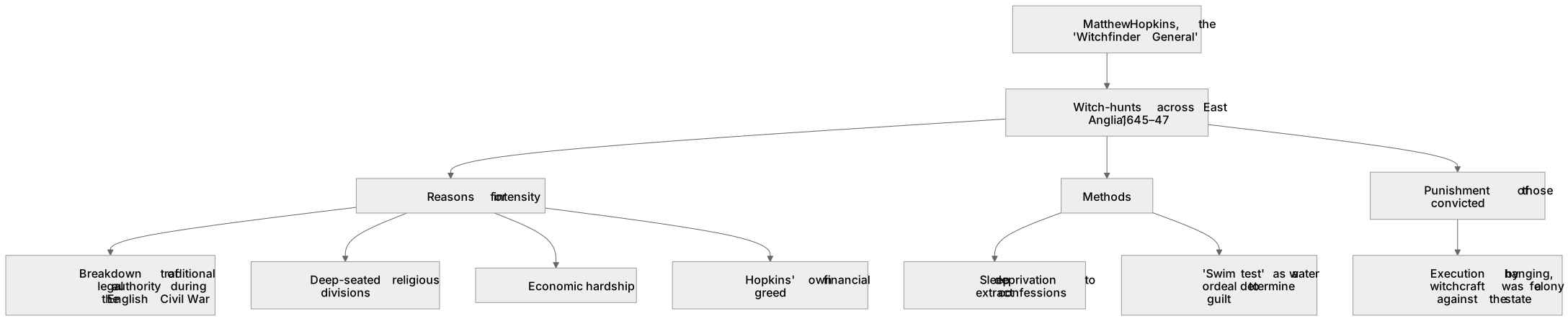
Matthew Hopkins, the self-styled 'Witchfinder General', exploited the chaos of the English Civil War to lead intense witch-hunts across East Anglia between 1645 and 1647. The intensity of these hunts was driven by several factors: the breakdown of traditional legal authority during the war, deep-seated religious divisions, economic hardship, and Hopkins' own financial greed, as he charged towns for his services. He used sleep deprivation to extract confessions and the 'swim test' as a water ordeal to determine guilt. The punishment for those convicted of witchcraft was severe; in England, this typically meant execution by hanging, rather than burning, as witchcraft was treated as a felony against the state. Over 100 people, mostly vulnerable women, were executed during this brief but intense period.
What earns the marks
- Identify Matthew Hopkins as the 'Witchfinder General' who led the East Anglian witch-hunts between 1645 and 1647.
- Explain the reasons for the intensity of the hunts, including the disruption of the English Civil War, economic crisis, and religious tensions.
- Describe the methods used by Hopkins, distinguishing between sleep deprivation to secure confessions and the 'swim test' to determine guilt.
- State that the punishment for convicted witches in England was hanging, as it was a felony, not burning.
Common mistakes and how to put them right
Stating that convicted witches in England were burned at the stake.
Put it right: They were hanged, as witchcraft was a felony, whereas burning was used in Scotland and Europe for heresy.
Confusing the purpose of the 'swim test'.
Put it right: It was an ordeal to determine guilt (if they floated, they were guilty), not a method of extracting a confession like sleep deprivation.
Ignoring the context of the Civil War.
Put it right: The breakdown of assize courts and local authority during the Civil War was a primary reason for the intensity of the hunts.
Exam tips
- Link the actions of Matthew Hopkins directly to the broader context of the English Civil War to explain why local authorities allowed him such power.
- Use specific examples of his methods, like the 'swim test' and sleep deprivation, to demonstrate how he manipulated the legal process.
Try the lesson
The start of the Option 10: c1500–c1700: Crime and punishment in early modern England - 3 Case studies ● The Gunpowder Plotters, 1605: their crimes and punishment.: Key individual: Matthew Hopkins and the witch-hunts of 1645–47. The reasons for their intensity; the punishment of those convicted. lesson, made from checked teaching notes for this specification point.
Have a go first
What was the standard legal punishment for those convicted of witchcraft in England during the 1645–47 witch-hunts?
Listen
Matthew Hopkins, the self-styled 'Witchfinder General', exploited the chaos of the English Civil War to lead intense witch-hunts across East Anglia between 1645 and 1647. The intensity of these hunts was driven by several factors: the breakdown of traditional legal authority during the war, deep-seated religious divisions, economic hardship, and Hopkins' own financial greed, as he charged towns for his services. He used sleep deprivation to extract confessions and the 'swim test' as a water ordeal to determine guilt. The punishment for those convicted of witchcraft was severe; in England, this typically meant execution by hanging, rather than burning, as witchcraft was treated as a felony against the state. Over 100 people, mostly vulnerable women, were executed during this brief but intense period. A strong answer earns marks for these points. Identify Matthew Hopkins as the 'Witchfinder General' who led the East Anglian witch-hunts between 1645 and 1647. Explain the reasons for the intensity of the hunts, including the disruption of the English Civil War, economic crisis, and religious tensions. Describe the methods used by Hopkins, distinguishing between sleep deprivation to secure confessions and the 'swim test' to determine guilt. State that the punishment for convicted witches in England was hanging, as it was a felony, not burning. A common slip: Stating that convicted witches in England were burned at the stake. Instead, they were hanged, as witchcraft was a felony, whereas burning was used in Scotland and Europe for heresy. Exam tip: Link the actions of Matthew Hopkins directly to the broader context of the English Civil War to explain why local authorities allowed him such power.
See it
Key words
Say what each word means before you turn the card.
Witchfinder General
Try answering aloud or in your head before turning the card.
swim test
Try answering aloud or in your head before turning the card.
sleep deprivation
Try answering aloud or in your head before turning the card.
felony
Try answering aloud or in your head before turning the card.
See every definition
- Witchfinder General
- The self-styled title of Matthew Hopkins, who led intense witch-hunts across East Anglia between 1645 and 1647.
- swim test
- A water ordeal used to determine guilt, in which a person who floated was considered guilty.
- sleep deprivation
- A method used to extract confessions from those accused of witchcraft.
- felony
- The category under which witchcraft was treated in England, meaning those convicted were typically executed by hanging rather than burning.
Label the diagram
Some boxes have lost their names. Pick the right name for each number.
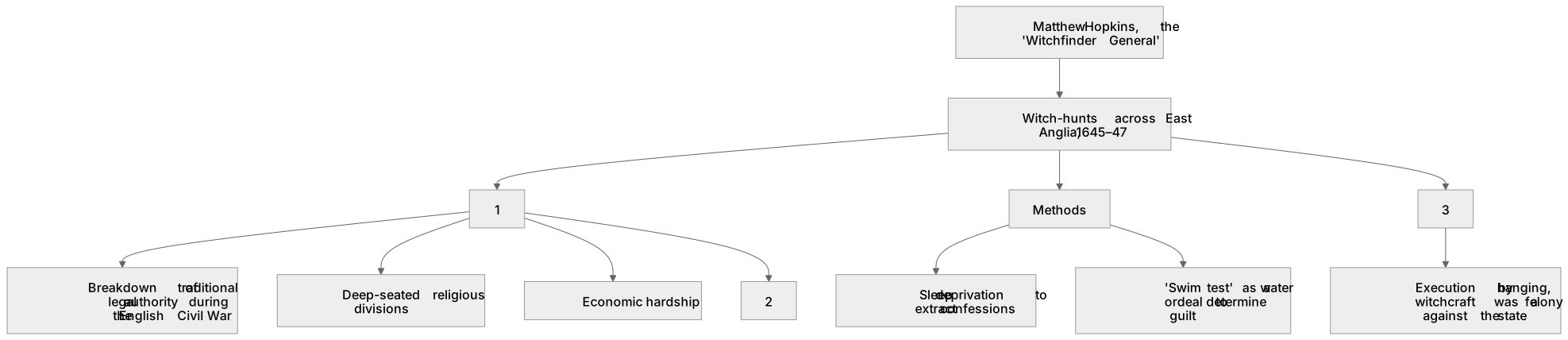
1Box 1
2Box 2
3Box 3
There is more to this lesson
The full lesson goes on to check your understanding and help you earn the marks. Create a free account to carry on, with your progress saved.
A week of Premium from your first lesson · Then the free plan continues · No card, no charge
Test your understanding of Option 10: c1500–c1700: Crime and punishment in early modern England - 3 Case studies ● The Gunpowder Plotters, 1605: their crimes and punishment.: Key individual: Matthew Hopkins and the witch-hunts of 1645–47. The reasons for their intensity; the punishment of those convicted.
Active recall beats re-reading. Take an instant quiz now to test what you’ve learned and lock it into long-term memory.
A week of Premium from your first lesson · Then the free plan continues · No card, no charge